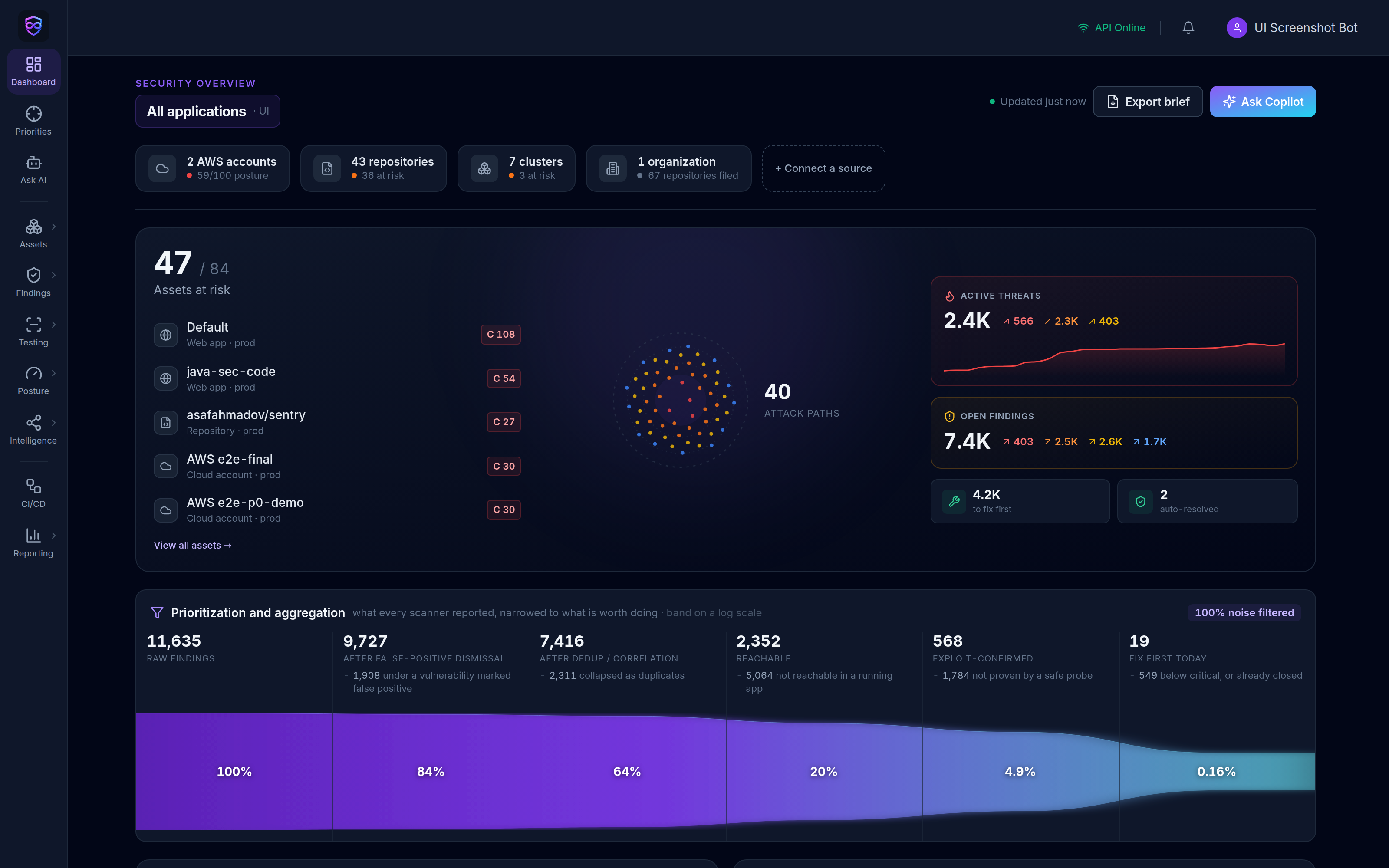
The actual product, not a render. This is the security overview your team opens every morning.
One self-hosted platform that confirms each vulnerability with a benign, safe proof - a captured request and response, no destructive actions - then blocks the risky build before it ships. Your source code and data never leave your infrastructure.
The actual product, not a render. This is the security overview your team opens every morning.
Agentic Pentest reasons over your app the way a tester would: form a hypothesis, send a bounded probe, read what came back, escalate. Every step is visible in the Agent Cockpit - and the verdict still comes from a deterministic oracle, never "the model said so."
/api/orders/{id}Attack Trace: the full kill chain, with a masked proof receipt - not a CVSS number.
Every confirmed finding ships with the exact benign probe we sent, the response that gave it away, and the oracle that decided it. No payload runs anything destructive - and nothing reaches this page that we could not reproduce.
GET /api/orders?id=1%20AND%207919*7907=62615533 HTTP/1.1
Host: shop.internal
HTTP/1.1 200 OK
{"orders":[{"id":1,"total":"149.00"}]}

# benign baseline · id=1 AND 7919*7907=1
HTTP/1.1 200 OK
{"orders":[]}
Arithmetic differential oracle: the true product (62615533) returns the row, the false one returns nothing. The query is executing our input - not a heuristic, a proof.
POST /profile HTTP/1.1
Host: app.internal
Content-Type: application/x-www-form-urlencoded

display_name={{7*170}}HTTP/1.1 200 OK <h2>Welcome, 1190</h2>
The template engine evaluated 7*170 and rendered 1190 - a benign expression, never a real payload. Server-side template injection confirmed, RCE-class.
POST /fetch HTTP/1.1
Host: api.internal
Content-Type: application/json

{"url":"http://169.254.169.254/latest/meta-data/iam/security-credentials/app-role"}HTTP/1.1 200 OK {"AccessKeyId":"ASIA…","Token":"…","Expiration":"…"}
The response carried a live cloud-credential marker that is absent from a benign baseline request. SSRF reaching the instance metadata service - critical.
One platform, one source of truth, whoever opens it.
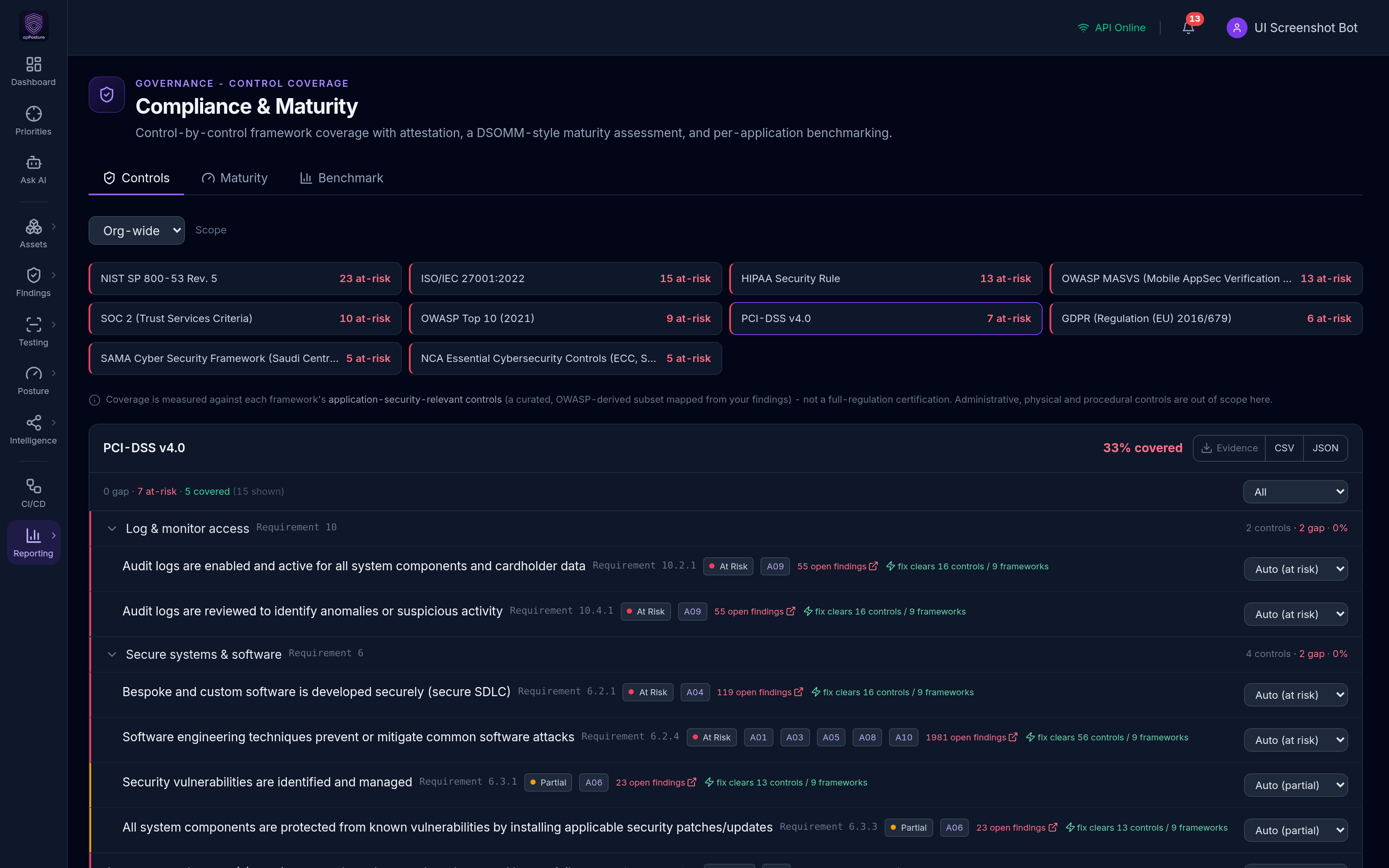
Every finding maps to the controls it touches
Twelve native disciplines, plus correlated ingestion of the tools you already run - everything collapses into a single, deduplicated, risk-weighted posture.
Dynamic testing that proves exploitation.
API security that ties code to runtime.
Static analysis that follows the real data flow.
Open-source risk you can actually act on.
Image CVEs without leaving the runner.
Infrastructure misconfig - and it grounds your threat model.
Kubernetes posture, scored and deduplicated.
Find leaked keys before attackers do.
Threat modeling that proves, not just describes.
One risk-weighted posture across every source.
Monitor first, block when you're ready.
Self-hosted does not mean self-service on the hard questions. Identity, audit, availability and updates are built in - and the evaluation material is here, not behind a form.
SSO (SAML / OIDC), role-based access with least-privilege defaults, MFA.
Tamper-evident audit log and an append-only evidence vault with retention you set.
High availability, encrypted backups, and offline CVE and template updates.
Findings mapped to OWASP, PCI-DSS, ISO 27001, SOC 2, NIST, HIPAA and GDPR.
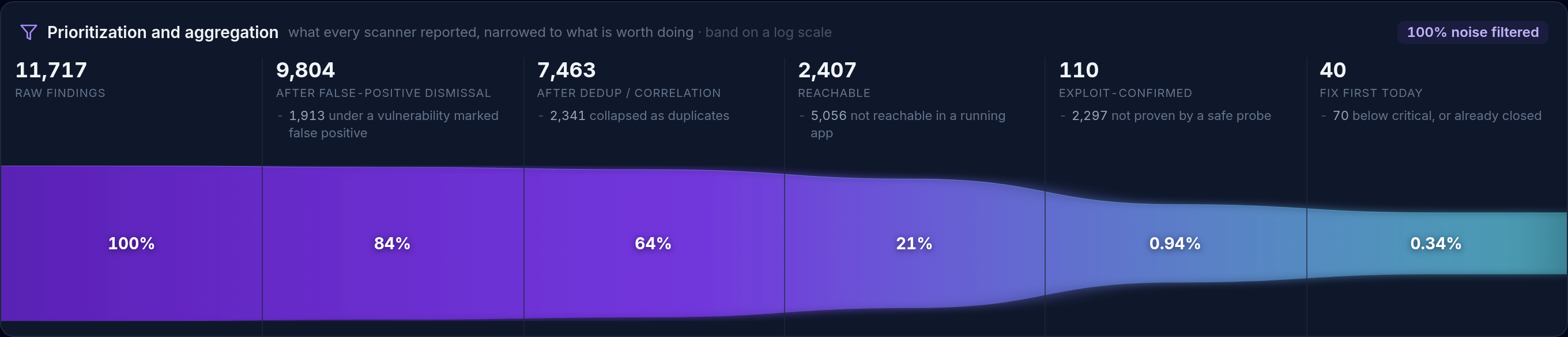
Not an illustration. This is the funnel from a live scan, exactly as the product draws it: correlation collapses duplicates, reachability drops what no running app can hit, and a safe probe has to prove the rest. Your ratio depends on your codebase; the method is the same.
Self-hosted is how most customers run it and what the platform was built around: scanners, correlation and the AI all local, so source, findings and evidence never leave. If you would rather not operate it, the same engine runs in your own cloud account or as a dedicated instance we manage - identical feature set in all three.
Your network, your keys, air-gapped capable. The local LLM means nothing is sent out for inference, and the platform works with no internet route at all.
The same install inside your AWS, Azure or GCP account. Residency and network policy stay yours; you skip running hardware.
A dedicated single-tenant instance we operate and upgrade. Never a shared pool, and you can move it in-house whenever you want.
Fits the tools you already run

From discovery to a proven attack chain. A PoC in your own environment.